'Albania Has All Chances for the Opening of Accession Negotiations'
Albanian Daily News
Published January 9, 2018
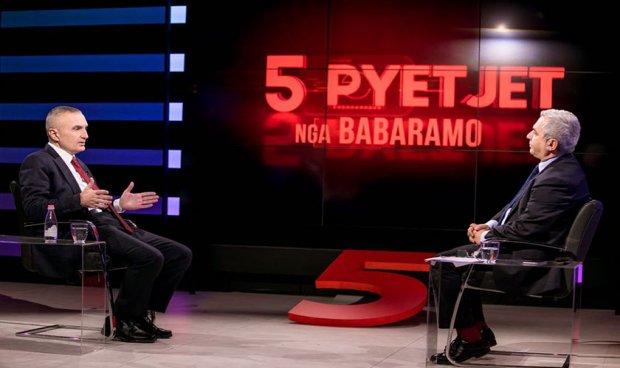
The President of the Republic Ilir Meta, unveiled in a long interview for the journalist Ilir Babaramo, his opinions for the most hot topics in Albania.
Below, his assessments for the election of the provisional chief prosecutor Arta Marku, the last declarations made by the Prime Minister Edi Rama that SP-SMI are not in a coalition anymore due to the judicial reform, the relationships with neighbor countries and diplomacy.
I would like to start our conversation from the most recent parliamentary session, one of the most chaotic parliamentary sessions during these 27 years of pluralism. A session finalized with the voting process for the Provisional Chief Prosecutor. The opposition labeled this voting process as a putsch and a usurpation of judicial system by Prime Minister Edi Rama. Meantime, PM Rama and his followers replied by saying that only those who fear the judicial reform are against this voting process. How was this voting from your point of view as the Head of State?
This episode may take us back by many years, in the aspect of fabrication of totally unnecessary and conflicting situations, when there exist the chance and willingness, if it is bilateral, to make principled, constitutional, transparent solution in accordance to the standard, which produce stable, credible uncontested institutions. I would like to emphasize the importance of a general focus on June of this year and the fulfillment of obligations by any political, institutional institution in this country, by the majority and the opposition in order not to miss another chance for Albania to open the accession negotiations with EU. In this regard, I think it is important to reflect on what happened in Albania systematically over the course of the 27 years when conflicts and exceptive spirit made the country to miss many chances earlier. Furthermore, Europe has no time to deal with us anymore due to other and more important problems. In this regard, we need to double or triple our efforts because during these six months, I think that the country has all the chances for the opening of negotiations. If this opportunity is missed then the costs for the country's European perspective and efforts to encourage youths, the creators to stay in Albania and devote themselves to the Europe�s realization here instead of seeking it abroad through migration would be much higher.
Does this unilateral vote, this unilateral decision of the ruling majority, cast any shadow of doubts or endangers the judicial reform?
I would not dwell just on this voting process, but I want to make a thorough assessment of what has happened with the judicial reform. In my opinion, it seems that we have gone back to the period of time ahead of July 21-22 2016, where unfortunately often, somewhere with a lack of transparency, somewhere in the trickery, somewhere in different shapes, we always had an attempt not to obstruct the judicial reform adoption by consensus in accordance to Venice recommendations. As is it always said, Albania makes good laws but fails to properly implement them.
So, I underline that this time we will not make a fatal mistake. Albania�s constitution as a whole is relatively positive in relation to the judicial reform issue. Despite some specifications that were made long ago by probably not foreseeing some developments in its implementation, which subsequently created some different interpretations regarding the establishment of new bodies.
I am not referring only to the Prosecution of the High Council of Prosecution (HCP) but I am thinking also about other institutions like the Justice Nomination Council (JNC) which is also experiencing a stalemate and remains non-functional since one year.
It is necessary to have a structured dialogue for the Justice General Inspector, for the vetting implementation process itself, because any further implementation of the reform in the conditions when the parties are involved in conflicts and intimidate each other does not help the major goals of this reform aimed to guarantee new bodies of a new judicial system, which are of the highest standards, built with transparency and at the same time are reliable and uncontested.
We find it difficult to make a fairly rational and constructive policy in continuity due to the totalitarian legacy of the past and the consequences it has left to us and to our society that feels still today the exceptive spirit, the desire to suppress the one another instead of observing his rights as a way to guarantee your rights tomorrow. Many reasons that are related to our Mediterranean temperament, or even the Balkans temperament, the desire to humiliate the adversary instead of defeating while at the same time respecting him.
But we all have the obligation, in particular in relation to issues concerning to the country�s European integration and the implementation of the judicial reform and related to long-term institutions which must induce a new level of confidence by the public, local entrepreneurs, foreign investors and every citizen toward the rule of law. It is more than necessary for the pairs to overcome themselves and cooperate with each other.
You talked about the extraordinary role played by the Venice Commission and by your side while in the office of Speaker when the judicial reform was adopted, or at least it constitutional basis were created. Can you make the difference between the project initially submitted by the government and the interventions of the Venice Commission? What is noticed?
I do not wish to make any more comments, because I do not want to take over undeserved credits. I think that the judicial reform adopted on July 21-July 22 was comprehensive. The Venice Commission played a determining role on view of the fact that it has been and remains the most reliable institution. Now it is important to proceed along this line. I think that every delay of a well-structured dialogue on these issues is not helpful but corrosive for the new bodies of justice reliability and functioning, which is critical for the entire reform.
We have been told that we make good laws but fail to properly implement them. Time has come for a general, principled, transparent, that meets the standards and far from conflicting rhetoric implementation. The solution lays in the Constitution, dialogue and transparency.
If communications will continue through accusations in TV or rallies on the judicial reform issue then we will have just an effort to blame each other for the reform�s infringement, or even the risk of accession negotiations opening failure in the future. In the end there will be no winners and Albania, it citizens, the youths, ill be the one to lose the most.
Berisha has used harsher tones than other opposition leaders. He asked from opposition�s MPs to burn down their mandates. What effects may this have?
I have been and remain a supporter of participation in any case in democracy, regardless of the standards of functioning of democracy or even of the parliament itself. Even the most developed democracies have their ups and downs, so you do not mind me saying them that I do not agree with Berisha.
At the last meeting of the Socialist Party (SP) National Assembly this weekend, Prime Minister Edi Rama said that he ended the coalition with Socialist Movement for Integration (SMI) when you were the leader of this political force due to your objection toward the judicial reform. Why did you object the judicial reform?
First of all, the coalition ended or was not reconfirmed not at the time I was the chairman of the SMI, but during a period of time when Mr. Petrit Vasili was chairman, because I resigned after being elected as country�s President. Secondly, it is not up to me to talk about SP-SMI relations, much more in this period, but for the past period, since we are talking about the judicial reform, there existed only one problem: I have always insisted with a heroic, unprecedented insistence that the reform should be done according to Venice standards and through consensus. And consensus can only be found in Venice, nowhere else. And fortunately sot it happened and the constitutional changes were realized in this way. Why did I insist so much? Because, thanks to my 25-year experience in parliament and political life since the 1990s, starting with the Students Movement �Let�s Make Albania Like All Europe�, I know, and I do not need to hear it from any ambassador, from any Western European state, and I knew very well that if the reform would not had been done in this way there would never have been a positive recommendation by the European Commission for the opening of the accession negotiations of Albania with European Union. Even it was done with 94 votes, without the opposition�s consensus. Even it would have been done with 104 votes, with 120 votes, but without the political opposition, there would never have been a positive recommendation. I was totally aware of this fact, I am still totally aware that if parties will continue on this path, detaching from each other and placing each other in front of an accomplished fact further increasing the tensions Albania will register another lost chance. Therefore, I appeal and insist that at least for this issue and other issues related to the key priorities of European integration parties should overcome themselves showing higher amenability. Even if they don�t like it, for the sake of a bigger interest, because I think that the future judgment will be very punitive for anyone who will not know how to help the country, because we have lost many opportunities in the past.
Let�s return to the allusion made by PM Rama last weekend. He alluded that you were contrary. From the independent judicial system, the judicial system reform�
They say that repetition is the mother of knowledge, but in such cases is the mother of lie and deception. I don�t believe that he was referring to me. Others know it too: There is no extraterrestrial power to frighten me neither with justice nor with injustice.
My only concern as politician is the justice for Albanian people. I am neither a prosecutor nor a judge. I respect them and I want them to be always independent and supported in their work. I am a politician who has faced with justice, whose rights have been violated, who has asked to be inquired and I am now here and will continue to be in politics for a long time, although I wish and will keep wishing to promote the youths in politics as I have done in the past. So these are just political games for media consumption. We often see disgusting declaration by all sides: They are afraid! He is afraid. That one is scared. Let�s serve to the correct and transparent implementation with standards of the constitutional changes that have been approved by consensus for the establishment of new judicial bodies enabling for all prosecutors, all judges, High Council of Justice (HCJ) inspectors, the High Council of Prosecution and all the others to not feel compelled toward one party or two parties or to three parties for the position that is assigned to them. Because then they are hostage to this political or partisan support, when instead the credits should go only to their skills, integrity. They should serve to professionalism in the future, in order to make the judicial system a respected one and accepted by everyone.
Beyond the personal aspect, I would like to ask you, because we live in Albania and have been following Albanian politics since 25 years, there have been even political trials, there has been an misuse of the prosecution...
If you deal with politics in Albania and are afraid of political trials, it is better not to deal with it! I think we should detach ourselves from this experience because we know it very well what has happened since Fatos Nano's political imprisonment, and other cases. I think that the politicians� obligation is to correctly implement constitutional changes to the establishment of new judicial institutions. Then let them debate all day for other issues: about the budget, about health, about agriculture, about everything they can, but we need to have long-term joint institutions.
Not of the politics, but of society, of citizens, of the state. We need to strengthen the citizens, investors and entrepreneurs judicial safety and we have a obligation to avoid the placement of question marks on the democratic system safety and warranties.
You are not sure, on view of the fact that you may interrupt your mandate as the Head of State?
When I say�No, this idea has never crossed my mind, on contrary. I have never considered this option because the presidency is a legal institution and it is my duty to protect the legitimacy and integrity of this institution in the interest of the country, not in my personal interest. No way! Second, when I say that I will remain in politics for a long time, I keep in mind the fact that I am a political being. Even now I am implementing the president�s policy. I'm not doing politics of any political force, on the contrary. And when a man is a politician, he thinks politically even when he walks.
In fact your competencies are nearly honorific. What can you do?
I do not think that this is a matter of competencies. This is a matter of responsibility and I will maximally exercise my responsibilities and in a highly transparent manner without ever being compromised by any partisan interest or from previous personal political relations.
Let talk about Kosovo and the concern it has created in Western countries that have warned a very difficult situation for Kosovo after the efforts of party leaders who emerged from the war�s wing to abolish the establishment of the Special Court. How do you see this situation? Is there really anything to worry about in terms of Kosovo's integration and state-making process?
We are all following a debate that has been developed there, thus this is an issue that has been made public. I do not believe Kosovo's leaders will take decisions that could undermine the confidence in Kosovo there�s a lack of commitment toward the rule of law in relation to everything done so far fully in compliance with Kosovo's leading international partners, USA and EU.
Through their statements Thaci, Haradinaj and Veseli share the same attitude when they say that Kosovo is experiencing an historic injustice in the name of justice. Do you think they are right?
I cannot say if they are right or not, but in politics you will ever have to do even unjust sacrifices for some of the greatest goals.
The Minister of Diaspora, Pandeli Majo declared last week that the business is preventing Albania�s and Kosovo�s governments from completely opening the borders. Is it a wrongful statement made by the minister or the oligarchs on both sides of the Drin River are so powerful that they are imposed on governments as well?
I want to say that after the meeting of Kor�a on 27 November between the two governments we all expect to see much more concrete result in the overall cooperation between Albania and Kosovo in terms of opening markets, towards the unification of many standards, many concrete policies that do not serve neither to oligarchs nor businessmen but serve only to the citizens and increase production in Albania in Kosovo, increase the trade balance between our two countries and at the same time reduce prices, improve services, open up of jobs in Kosovo as well as in Albania.
You visited Pustec last weekend and warned a trilateral cooperation between Albania-Greece and Macedonia. What do you mean? Because this statement comes in such a context when the conflict between Macedonia and Greece is smoothing and the solution is being found. Which is your concept for this cooperation between these three countries?
Pustec is the ideal placed to talk about cooperation, not only between Albania and Macedonia but for even a more comprehensive cooperation between Albania-Greece and Macedonia on view of the fact that Prespa is included in all three countries. And I do not mean just Pustec, who is the main beneficiary, but also Devoll and Korca, and the opportunities to benefit from joint programs. Even the opportunities to benefit from EU are much greater. I think that 2018 will be a historic year for relations between those three countries and the Albania-Macedonia relation that is the simplest, even Albania-Greece, which is still simpler, but also the Macedonia-Greece relation, which is a bit more difficult, but it is completely possible.
The second round of talks between the two foreign ministers, Bushati and Kotzias is expected to take place after 10 days, following the Crete meeting to smooth out all the open issues that exist between the two countries. Has the foreign minister informed you about what happened in Crete? Which are the agenda and expectations?
This is an issue of very low interest. What is the most important, which I support, not with Greece, but with all neighboring countries, is an open policy of friendship, cooperation, overcoming problems by doing acts of trust and not creating a spirit of mistrust. In this regard, I have always been determined that we should be and have nothing to lose when we are sometimes asymmetric with the neighbors. It is important to be on the right path, to be on a European path, to be on a road that offers trust for others, because even the others, if they are wrong, will reflect and return to them the spirit of trust and cooperation. So any dialogue aimed at overcoming all or most of the problems that exist between the two countries have my support and of course in the right time everything will also be transparent to the public.
Two years ago, when the tensions were at its peak, you at the helm of a parliamentary delegation visited Athens and were welcomed by the top Greek state leaders. Media claimed that you had managed to find a solution with Greek counterparts but it encountered some difficulties. What happened and if you had achieved something, is it similar to what is being achieved now?
I do not want to go back in time nor serve to the conspiracy theories. I was on a visit to Greece at a tense moment because it coincided so at that time and I tried to extinguish the fire because throwing gas in the fire here in the Balkans is the easiest job, but it's a job for lazy and irresponsible people. It is not for responsible people who are responsible for both countries, but also for people. Because citizens are the ones that suffer the consequences of the irritations between the countries and we know very well this fact, as they do even better than us. They immediately notice the temperature of the relations between the two countries. So without going back, I can say that Prime Minister Tzipras has a very positive merit and I obviously have the highest consideration for President Pavloupulos and for all the others. I have maximal confidence on his willingness and positive energy I think this fact is confirmed even by our immigrants in Greece who have seen a different approach from this government and Prime Minister since its raise to power. And I think that it can easily be reflected in a very positive energy among our countries and I hope that this will happen even between Greece and Macedonia.


Politics
MORE
Economy
MORE
Social
MORE
Current Events
MORE
Op-Ed
MORE

Not Even a Provokacija

Even though the statement of the veteran ambassador of the Republic of Serbia in... January 10, 2018
World News
MORE